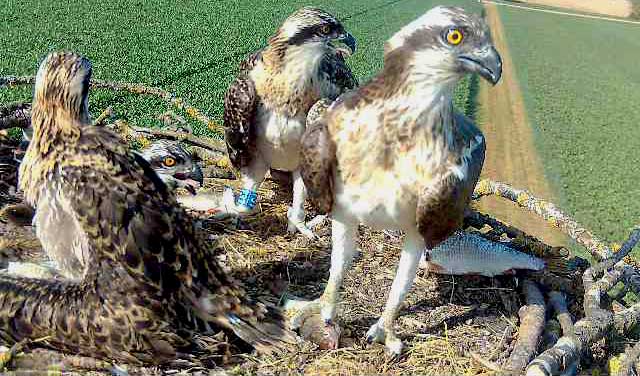
We are happy to report that a pair of Osprey have successfully bred in Switzerland for the first time in 112 years. The male had been released by the Nos Oiseaux project, and the female, unringed and of unknown origin, had already paired with him (while she was still immature) during the summer of 2025. Both returned in March this year and it was as if they had read all the books published about the species. Courtship took place right upon their return, with the male bringing fish to the female and much mating. Three eggs were laid, starting on 19 April. They hatched starting on May 25, and the three young were ringed by Michel Beaud on July 6 (photo above with the female, taken by phototrap).
From their weight and measurements, there are two females and one male. The two females were named Somone (after a community reserve in Senegal) and Khnifiss (after a National Park in Morocco), and the male Diawling (after a National Park in Mauritania). They were named after protected wetlands in West Africa (also designated as Ramsar Sites) well known to host wintering Osprey.
A very dedicated team of Osprey watchers has kept a discreet and nearly permanent eye on the breeding site from a distance of over 600m, to monitor progress and ensure that there was no disturbance. All were impressed by the female in how she protected her eggs during cold, wet days in spring (well seconded by the male, which brooded the eggs for about 20% of the time during the day). Then during the record heatwaves that followed since the end of May, she stoically protected her chicks from the hot sun by opening her wings like a parasol so that they could stay in her shade during the entire day. The male’s fundamental role is to bring fish for all the family to the nest, a task which he has accomplished magnificently (feeding three hungry chicks and their mother is a lot of work)!
Now that the young have fledged, they will stay in the region and continue to be fed by the male until the end of August or the beginning of September when they will leave on migration. Until then, it should be possible to see them at the lakes of Neuchâtel, Morat or Bienne, or even along the Aare River. Since the migration season has started, it is becoming more difficult to know if the birds are local or passing through, knowing however that Swiss Osprey have a blue ring on the right leg. Any observation of a ringed bird is as always welcome, either posted on ornitho.ch or sent directly here.
Many thanks again to all the team that have spent a huge amount of time watching over this first Osprey family in Switzerland for over a century, as well of course to all the generous donors which have made this project possible.

